
Technology
About Urea
From syngas to fertiliser
Urea is one of the world’s most widely used nitrogen fertilisers and an important end product that can be produced from ammonia.
For NeuRizer, urea is particularly relevant because the NeuRizer Urea Project is designed to use UCG-derived syngas as the starting point for ammonia and urea production at Leigh Creek, South Australia.
Why urea matters
Nitrogen is essential to crop production and must be replenished as agricultural activity removes nutrients from the soil.
Urea contains 46% nitrogen, making it one of the most concentrated solid nitrogen fertilisers. It is widely traded, straightforward to transport and store, and used extensively across global agriculture.
Australia relies heavily on imported urea, making security and diversity of supply an important consideration for Australian agriculture due to its safe to use and handling.
One tonne of granular urea contains 460 kg of nitrogen.
From underground resource to urea
NeuRizer’s proposed pathway begins with Underground Coal Gasification.
- Suitable coal resource
- UCG
- Syngas
- Hydrogen / ammonia
- Urea
UCG converts suitable underground coal into syngas. That syngas can then be processed to provide the hydrogen required to produce ammonia.
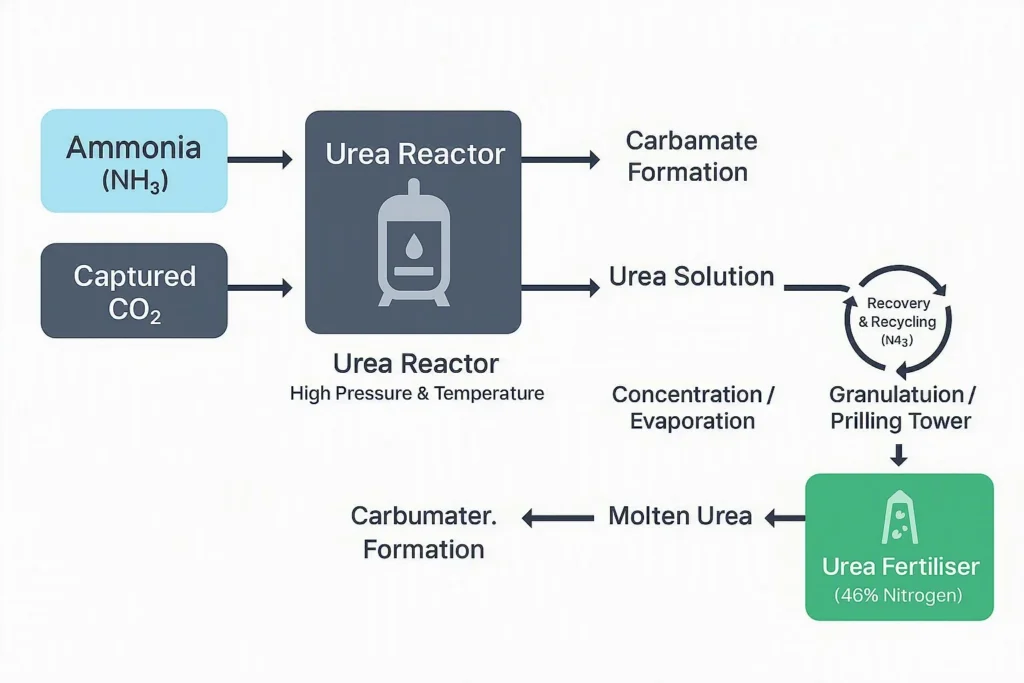
Ammonia is subsequently combined with carbon dioxide to produce urea.
What is urea?
Urea is a nitrogen-rich compound widely used as fertiliser and in a range of industrial applications.
Commercial fertiliser-grade urea contains approximately 46% nitrogen and is generally produced in granular form, making it suitable for storage, transport and agricultural distribution.
Key characteristics
- High nitrogen content
- Stable granular product
- Straightforward to transport and store
- Widely used in agriculture
- Also used in industrial applications
- Safe to use and handle
How urea is produced
Most conventional urea production begins with natural gas.
NeuRizer’s proposed pathway differs at the beginning of that chain.
At NRUP, UCG-derived syngas would provide the feedstock from which hydrogen is produced, before progressing through ammonia to urea production. The downstream ammonia-to-urea stages then follow the established fertiliser-production pathway.
Technology
From urea pathway to project development
See how NeuRizer proposes to apply this pathway at Leigh Creek.