
About
Company Overview
Company overview
NeuRizer at a glance
NeuRizer Limited is an Australian energy technology and project-development company focused on Underground Coal Gasification (UCG), also referred to as In-Situ Gasification (ISG). UCG converts suitable underground coal resources into syngas, without conventional extraction of the coal to the surface.
NeuRizer’s experience has been built through the development and operation of a successful pre-commercial UCG demonstration at Leigh Creek in South Australia, subsequent downstream project evaluation, and the progression of commercial relationships relating to its technology and equipment.
Focus
Underground Coal Gasification (UCG)
Also referred to as
In-Situ Gasification (ISG)
Demonstration
Leigh Creek in South Australia
The UCG pathway
What NeuRizer does
NeuRizer works across the UCG project-development pathway: from resource and technical assessment, through project design and operation, to evaluation of downstream applications for the syngas produced.
Step 01
Resource and technical assessment
Step 02
Project design and operation
Step 03
Evaluation of downstream applications for the syngas produced
One feedstock, multiple markets
Syngas can be used as an industrial feedstock for a range of applications, including power, synthesis gas and the manufacture of products such as ammonia, urea, hydrogen and methanol, depending on the project configuration and market demand.
Energy: power, synthesis gas
Products: ammonia, urea, hydrogen, methanol
Our reach
From Australian experience to wider application
- Completed
Leigh Creek, South Australia
Australia
Leigh Creek remains the foundation of NeuRizer’s practical UCG experience.
- Current
Reliance Industries
India
In March 2026, NeuRizer announced Letters of Award (now binding contracts) with Reliance Industries covering technology transfer and the sale of UCG demonstration plant and equipment from Leigh Creek. This relationship represents an important part of NeuRizer’s international commercial activity.
- Future opportunity
Overseas markets
International
The company is also pursuing opportunities to apply its technology, know-how / operational performance and project-development capability in other overseas markets where geology, regulation, commercial agreements and end-use demand support a viable project pathway.
Proposed development
The NeuRizer Urea Project
In Australia, NeuRizer is progressing the proposed NeuRizer Urea Project (NRUP) at Leigh Creek. The project is designed around the use of UCG-derived syngas as a feedstock for ammonia and urea production.
NRUP remains a development project and is subject to the technical, environmental, regulatory, commercial, financing and investment decisions required for a project of this scale.
Transparency
How we present our progress
On this website, NeuRizer distinguishes between completed work, current activity, proposed development and future opportunity. This is intended to make it clear what the company has already demonstrated, what is being progressed today and what remains subject to approval or future commercial decisions.
- Completed
What the company has already demonstrated
- Current
What is being progressed today
- Proposed
Proposed development
- Subject to approval
What remains subject to approval
- Future opportunity
Future commercial decisions
Frequently Asked Questions
About NeuRizer
The company’s history and name, where it operates, and the UCG experience behind its work.
Why did Leigh Creek Energy become NeuRizer, and what does the NeuRizer name mean?
NeuRizer was previously known as Leigh Creek Energy Limited and changed its name to NeuRizer Limited in March 2022 following shareholder approval.
The change reflected the Company's evolution from being identified primarily with the Leigh Creek location to a broader business focused on the NeuRizer Urea Project, its proprietary Underground Coal Gasification (UCG) technology and future commercial applications of its technology and expertise.
The name "NeuRizer" was developed by a marketing company in consultation with the Company. "Neu" represents a new approach to energy and resource development, while "Rizer" represents both the syngas rising from beneath the earth and the broader idea of industry, infrastructure and economic activity rising from the energy it creates.
The name therefore captures what the Company is seeking to do: unlock deep, otherwise stranded coal resources and convert them in situ into syngas that can support electricity, industrial development, fertiliser production and data-centre infrastructure.
Where is NeuRizer active internationally?
NeuRizer is an Australian company with its principal operating and technical experience, and UCG proof base, at Leigh Creek in South Australia, where it successfully demonstrated its Underground Coal Gasification technology and is progressing the NeuRizer Urea Project.
Internationally, the Company is working with Reliance Industries Limited in India following agreements announced in March 2026 covering UCG technology transfer and the sale of NeuRizer's demonstration plant and equipment, applying the Company's technology, equipment and technical expertise to Reliance's coal gasification development program.
NeuRizer is also evaluating opportunities in other international markets where suitable coal resources could potentially be converted into syngas for electricity, industrial energy, fertiliser feedstock, power for data-centre infrastructure and other downstream products.
As these opportunities progress, NeuRizer will identify individual countries and counterparties, and any material new projects, counterparties or commercial agreements will be disclosed through the appropriate ASX channels.
What UCG experience and capability does NeuRizer have?
Why is NeuRizer regarded as the world leader in UCG?
NeuRizer’s position is built on a combination of real operating experience, substantial investment, independently certified resource outcomes, regulatory approvals, proprietary technology and international commercial validation.
Since 2015 the Company has invested more than A$150 million developing and successfully operating its UCG technology at Leigh Creek in South Australia, where it completed a commercial-scale demonstration and safely produced syngas at rates exceeding 1 MMcfd. That work was undertaken across a section of its coal resource which exceeds more than 300 million tonnes, providing NeuRizer with extensive geological, engineering, operating and environmental data that very few UCG developers globally possess.
NeuRizer has also secured independent PRMS certification, evaluation by Sproule ERCE, Australian regulatory approvals and a Petroleum Production Licence, while developing proprietary technology and practical expertise across resource assessment, well design, gasifier operation, syngas production, environmental management, technology transfer and commercial development.
Most importantly, that expertise is now being recognised internationally. India’s largest company, Reliance Industries Limited, has chosen NeuRizer’s UCG process, technology, plant, equipment and experienced personnel to support its major UCG development program in India, including acquiring rights to use NeuRizer’s technology in India and drawing on the Company’s accumulated operating know-how.
That is why NeuRizer can credibly position itself as a world leader in UCG: it has spent the capital, operated the technology, generated the data, secured independent and regulatory validation, built a substantial resource base and is now transferring that expertise into one of the world’s largest emerging UCG markets.
Frequently Asked Questions
Understanding UCG
How underground coal gasification works, where it has been used, and what it takes to develop a project.
What are the advantages of UCG compared with conventional coal mining?
Underground Coal Gasification takes a different approach to using coal resources. Instead of mining, transporting and handling solid coal, UCG converts suitable coal underground into syngas and brings the gas to the surface through production wells.
In suitable geology, this can offer a number of advantages, including:
- No open-cut or conventional underground coal mine
- No large-scale coal extraction or haulage
- A smaller surface footprint
- Reduced coal-handling infrastructure
- Access to deep or otherwise stranded coal resources
- No requirement for large-scale dewatering of the coal seam
- The ability to use syngas for electricity, industrial energy, hydrogen, ammonia, urea and other applications
- Potentially different capital and operating economics from conventional mining and surface gasification
The suitability and advantages of UCG remain project-specific and depend on geology, engineering, environmental requirements and the intended use of the syngas.
How does UCG produce syngas, and what can syngas be used for?
- Electricity
- Industrial heat and energy
- Hydrogen
- Ammonia and urea fertiliser
- Synthetic fuels
- Chemicals and other industrial products
- Dedicated power for energy-intensive infrastructure
The many uses of syngas
A versatile building block for a more sustainable future
SYNGAS
CO + H2
A mixture of carbon monoxide and hydrogen
A versatile pathway
01 →
Diverse sources
02 →
Syngas production
03 →
Versatile building block
04
Endless possibilities
Power generation
Syngas can be burned in gas turbines or engines to produce electricity and heat.
Fertiliser
Syngas is used to produce ammonia (NH3), a key ingredient in nitrogen fertilisers that help feed the world.
Liquid fuels
Syngas can be converted into liquid fuels such as methanol, dimethyl ether (DME), gasoline, diesel, and sustainable aviation fuel (SAF).
Hydrogen production
Syngas can be shifted to produce high-purity hydrogen for industrial use, energy, and fuel cell applications.
Chemicals
Syngas is a building block for many chemicals including methanol, acetic acid, oxo alcohols, and many others.
E-fuels & synthetic feedstocks
When combined with CO2, syngas can create synthetic fuels and materials with a lower carbon footprint.
How a UCG site is laid out
Infrastructure
Gas processing facility
Production well
Injection well
Ignition well
Automated controlled retracting injection point
Geology
Telford Gravels
Main Series overburden (Carb. Mudstone)
Coal seam (Main Series)
Dimensions
Depth to the coal seam
Coal seam thickness
Horizontal length in the seam
How complex is UCG to develop and operate?
The basic principle of UCG is straightforward: drill wells into a suitable coal seam, convert part of the coal underground into syngas and bring that gas to the surface.
The complexity lies in doing this safely, efficiently and consistently.
Successful UCG requires suitable geology, appropriate well design, controlled gasifier operation, groundwater and environmental management, syngas processing, monitoring systems and regulatory approvals.
NeuRizer developed practical experience across these areas through its Leigh Creek demonstration, including operating within South Australian environmental and regulatory requirements.
This operating experience and accumulated technical knowledge form an important part of the Company's UCG capability.
Where has UCG been successfully operated?
UCG has been demonstrated and operated in several countries over many decades, including Australia, Uzbekistan, South Africa, the United States and the former Soviet Union.
One of the longest-running examples is the Angren operation in Uzbekistan, where UCG production began in the 1960s.
South Africa's state-owned utility Eskom also operated the Majuba UCG project, producing syngas from coal that was not considered suitable for conventional mining.
In Australia, NeuRizer completed its own pre-commercial demonstration at Leigh Creek in South Australia, generating operating data and practical experience that continues to support the Company's technical and project-development work.
These examples demonstrate that coal can be converted underground into usable syngas, although the suitability and economics of each project remain dependent on local conditions.
Can UCG be undertaken anywhere?
No. Suitable geology and careful site selection are fundamental to UCG.
Before a project is developed, factors including coal depth, seam thickness, coal quality, surrounding rock, permeability, groundwater conditions, faulting and environmental constraints must be assessed.
The coal seam also needs to provide appropriate conditions for the gasification process to be contained and controlled.
UCG can be particularly relevant to deeper coal resources that may not be economic or practical to mine conventionally.
If geological, environmental or operating conditions are not suitable, a UCG project should not proceed.
What does a UCG well pair look like and how much gas or electricity can it produce?
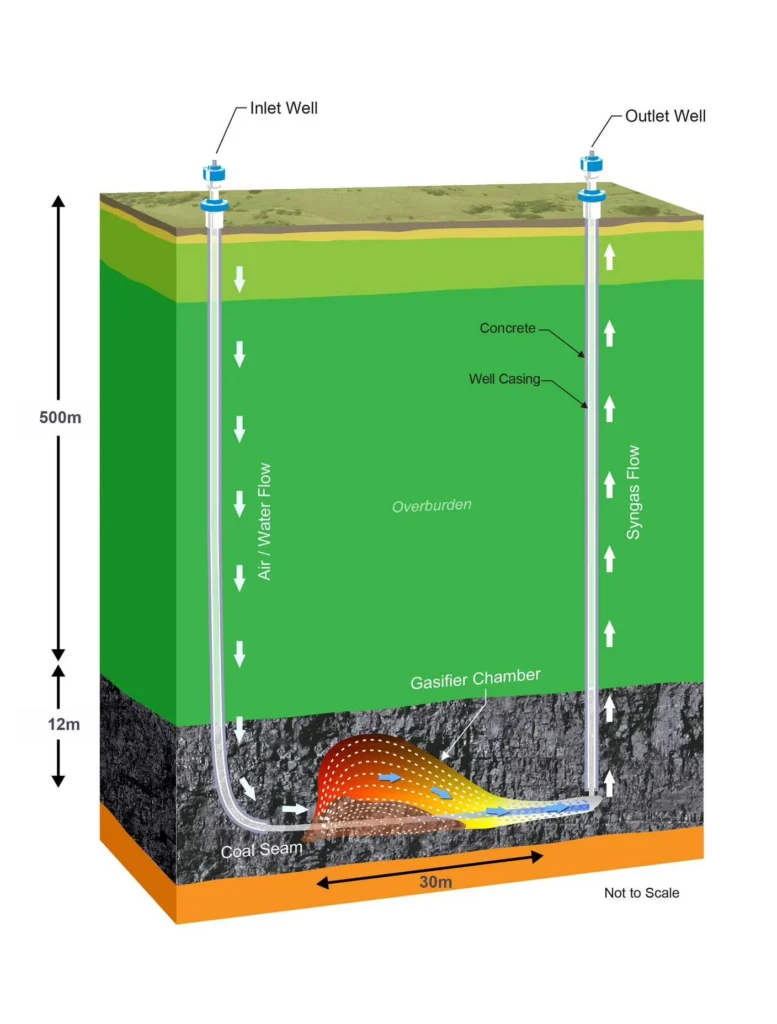
A typical UCG well pair consists of an injection well and a production well drilled from the surface into an underground coal seam.
At surface, the supporting infrastructure can include wellheads, piping, gas-conditioning equipment, monitoring and control systems, safety equipment and, where electricity is being generated locally, gas-fired generators.
The exact output of a well pair depends on the coal resource, well design and operating conditions.
For illustration, NeuRizer's current technical material uses a well pair producing around 4 PJ of syngas per year as sufficient to continuously fuel a 5 MW generator.
Commercial projects can be scaled by developing additional well pairs and surface infrastructure in parallel.
How long can a UCG operation produce syngas?
The operating life of a UCG development depends on the size and thickness of the coal resource, well design, gasification rate and the rate at which the resource is developed.
An individual well pair may operate for several years, depending on geology and operating design.
A larger UCG field can operate for much longer because new well pairs can progressively be developed in additional parts of the coal resource as earlier gasifiers are completed.
The overall life of a project is therefore determined by the usable coal resource and the rate at which successive gasifiers are developed and operated.
How quickly can a UCG project be developed?
There is no single development timetable for UCG.
Timing depends on resource assessment, geology, environmental studies, regulatory approvals, drilling, surface infrastructure and the intended end use of the syngas.
One advantage of UCG is that it can be developed modularly. A project can begin with a limited number of well pairs and expand progressively as additional production is required.
Once approvals and common infrastructure are in place, additional well pairs can be developed using established designs and operating systems.
This can provide a staged pathway from initial production to a larger commercial development, although the actual timetable remains project-specific.

Frequently Asked Questions
Environment, Monitoring & End-of-Life
How UCG is controlled and monitored, its environmental considerations, and what happens after gasification ends.
How is UCG controlled and monitored, and how is groundwater protected?
UCG is operated and monitored from the surface through the injection and production wells connected to the underground gasification zone.
Operators monitor factors including:
- Injection and production pressure
- Gas flow rates
- Gasifier temperature
- Syngas composition
- Well integrity
- Groundwater conditions
- Surface and subsurface environmental conditions
Pressure control is particularly important because the process is designed so that produced gases move towards the production well rather than migrating into surrounding formations.
Groundwater protection begins with site selection. Coal seams, surrounding rock, aquifers and groundwater conditions are assessed before development.
Monitoring wells may also be used before, during and after operations to track groundwater levels and quality.
What are the environmental considerations of UCG?
UCG can avoid a number of surface impacts associated with conventional coal mining because the coal itself remains underground.
Depending on the project, potential advantages can include:
- No open-cut or conventional underground mine
- No large-scale coal extraction or haulage
- A smaller surface footprint
- Less coal-handling infrastructure
- Reduced dust, noise and heavy mining activity
- No conventional overburden dumps or mine tailings
- Much of the coal's mineral material remaining underground
- The ability to treat syngas before its final use
UCG is not carbon-free. Its overall emissions and environmental performance depend on the resource, project design, gas treatment, end use and any carbon-management systems incorporated into the project.
For this reason, environmental performance needs to be assessed on a project-specific basis.
How much CO₂ does UCG produce, and can it be captured or stored?
UCG produces syngas containing several gases, including carbon dioxide.
The amount of CO₂ produced varies according to coal characteristics, gasifier design, operating conditions and how the syngas is ultimately used.
One advantage of gasification is that CO₂ can potentially be separated from the syngas at the surface before the remaining gas is used.
Captured CO₂ may then be compressed and transported for utilisation or geological storage through Carbon Capture and Storage (CCS) or Carbon Capture, Utilisation and Storage (CCUS).
Suitable storage formations can include deep saline formations, depleted oil and gas reservoirs and certain coal formations.
Research has also examined the potential use of spent UCG zones for geological CO₂ storage. Any such application would require detailed site-specific geological, environmental and regulatory assessment.
What happens underground after UCG is completed, and can it cause surface subsidence?
When a section of coal has been gasified, the underground reaction is stopped and the gasification zone is allowed to cool.
Residual char, mineral material and the remaining coal stay underground. The injection and production wells are then decommissioned and sealed in accordance with regulatory requirements.
Some underground movement or compaction can occur within the spent gasification zone.
Whether this creates measurable surface subsidence depends on factors including seam depth and thickness, overlying rock strength, faulting, gasifier geometry and local geology.
Subsidence risk is therefore assessed as part of site selection and project design, and monitoring can continue during and after operations where required.
Frequently Asked Questions
Economics & The Energy Mix
How UCG economics compare with conventional options, and how UCG could work alongside renewable energy.
Is UCG economically competitive with conventional coal mining and gas production?
It can be, depending on the project.
UCG changes the economics of developing a coal resource because it avoids the need to build and operate a conventional mine and can reduce or eliminate costs associated with coal extraction, haulage, crushing, handling and stockpiling.
It can also create potential value from deep or otherwise stranded coal resources that may have limited economic value as conventional mining assets.
However, UCG economics remain highly project-specific.
Factors include coal depth and thickness, drilling costs, well productivity, syngas quality, gas treatment, environmental controls, infrastructure, power-generation efficiency and the local cost of alternative energy sources.
The relevant question is therefore not simply whether UCG is cheaper than mining or gas, but whether a particular resource can be converted into useful energy economically under the conditions of that project.
What role could UCG play alongside renewable energy?
NeuRizer views UCG as potentially complementary to renewable energy rather than as a replacement for it.
Solar and wind can provide significant amounts of electricity, but their output varies with weather and time of day.
Industry, infrastructure and other high-demand users may also require reliable power at times when renewable generation is limited.
Where suitable resources exist, UCG-derived syngas can potentially provide continuous or dispatchable energy alongside renewable generation.
The role of UCG is therefore not simply “coal instead of renewables”. It can form part of a broader energy portfolio where different technologies are used to meet different reliability, infrastructure and industrial requirements.
